
The Douglas TBD Devastator

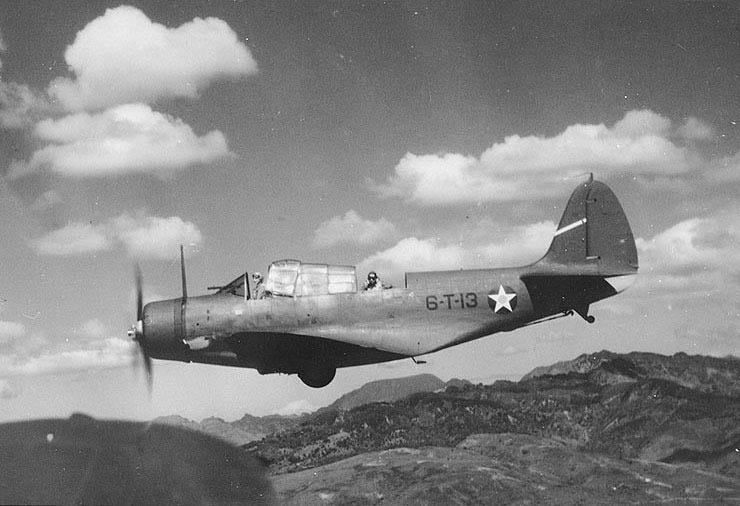
The Douglas XTBD-1 was ordered by the U.S. Navy on 30 June 1934, after winning a competition for new carrier based bombers -- other winners included the Vought SB2U Vindicator and the Northrop BT-1 (later to become the Douglas SBD Dauntless). The XTBD-1 first flew on 15 April 1935.
When the aircraft was first introduced to the fleet, it was the most advanced aircraft in any naval air force, but that was almost five years before the Pacific War. As a low-wing monoplane, with all metal construction, folding wings and semi-retractable landing gear, she was faster than the biplane aircraft she replaced, and in 1937, the TBD was the first such monoplane to operate from a carrier.
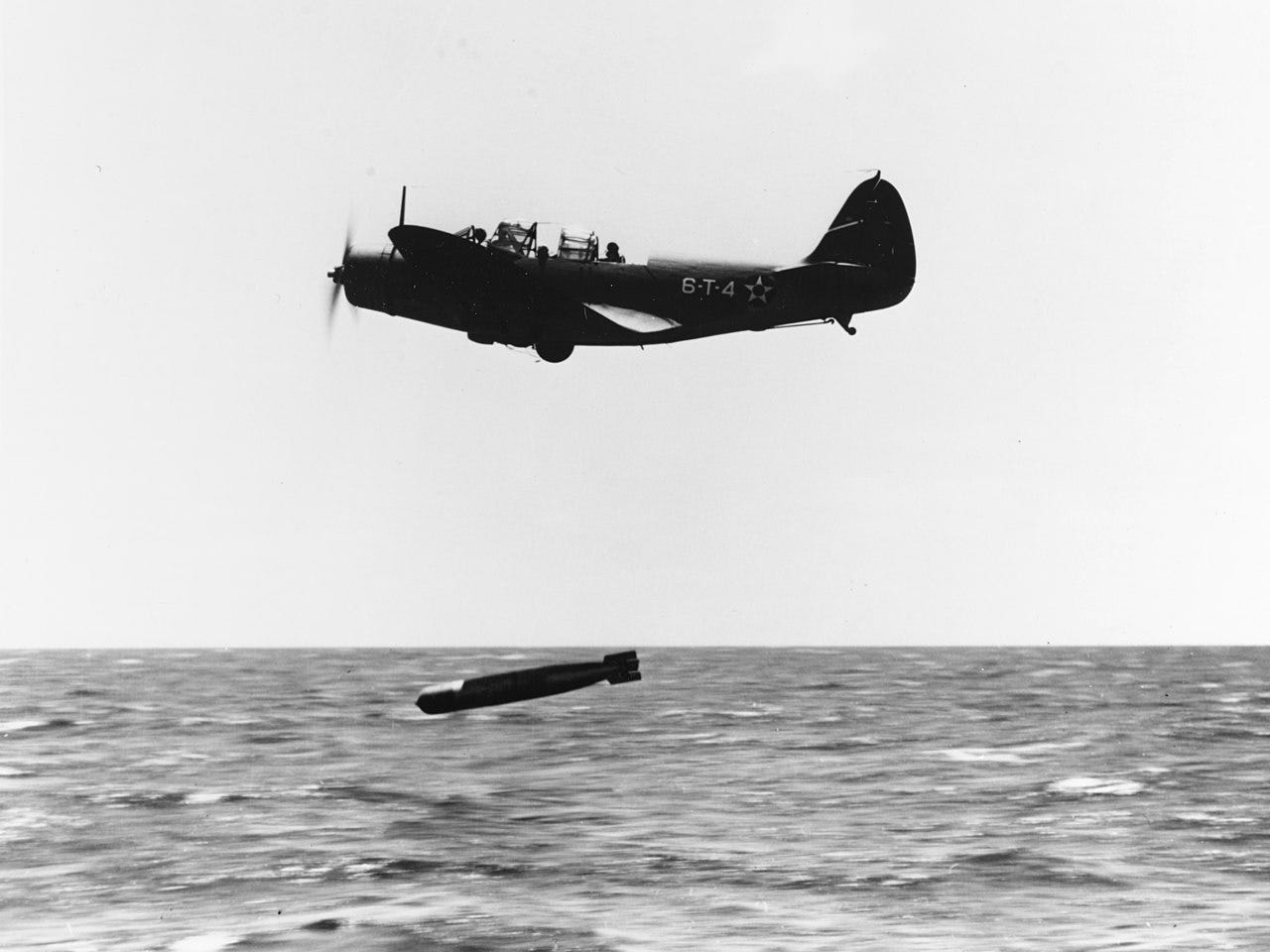
The TBD could carry a 1,935 lb torpedo or a 1,000 lb bomb semi-recessed in the fuselage. The aircraft could also carry three 500 lb bombs. The torpedo bomber was powered by an 850 hp Pratt & Whitney R-1830-64 Twin Wasp radial engine.
Later TBD pilots would be told the prototype once flew at 178 knots (204 mph), but the best they could manage in their birds was 130 knots (149 mph), and with a torpedo that was cut to 120 knots (138 mph. The torpedo was loaded so that it pointed down at a 10-degree angle, which was great if the pilot didn't want their “fish” to porpoise and run wild after they dropped it, but the increased drag really hampered their speed.
By 1940, the US Navy was aware that the TBD had become outclassed and a replacement, the Grumman TBF Avenger, was in the works, but it was not yet operational when the US entered World War II. Attrition had by then reduced their numbers to just over 100 aircraft. When the US Navy assigned popular names to its aircraft in late 1941, the TBD became the Devastator.
—
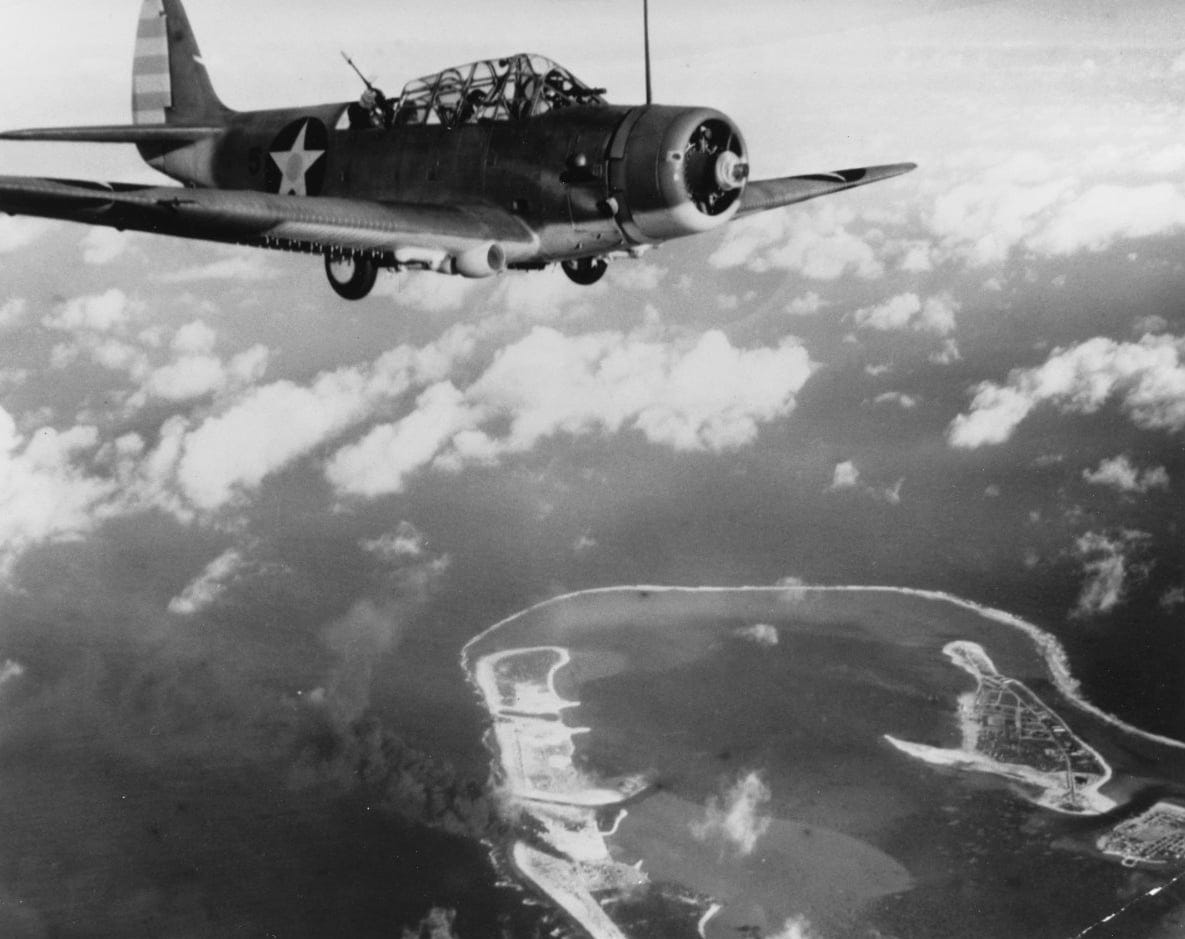
“One of history's most maligned aircraft, the TBD Devastator was no devastator of the Empire of the Sun, but neither was it the 'suicide coffin' it has been proclaimed to be,” wrote Barrett Tillman and Robert Lawson in their book U.S. Navy Dive and Torpedo Bombers of World War II. “In fact, it was a progressive design when it became the first carrier monoplane to enter American service in 1937.”
Tillman and Lawson went on to state:
The Douglas design included some seemingly halfway measures that actually made sense. The semi-retractable landing gear was intended to provide at least minimal cushion for the airframe in case of a wheels-up landing, even though other naval aircraft had fully retractable gear at the time. Similarly, the torpedo was only partially enclosed within the belly of the aircraft, the nose portion being exposed at a 10-degree downward angle. The latter provision was included as a means of ensuring a nose-first entry into the water to minimize any tendency to “porpoise” and broach the surface, which could result in an erratic run.
First flown in April 1935, the TBD was warmly greeted as a replacement for lumbering relics such as the Great Lakes TGs and Martin T4Ms. If for no other reason, the TBD – optimistically named “Devastator” by the joint army-navy committee in October 1941 – was guaranteed a place in history by replacing fabric-covered biplanes aboard American aircraft carriers. The prototype passed its carrier qualification trials aboard Lexington and prepared to join the fleet.
Wilhelm G. Esder, a pilot in VT-3 in 1938 said The TBD was “the most beautiful aircraft I had ever seen. After a few hours in the TBD I was sure it was the best plane the navy had at the time. It was faster than anything I had flown, and I was in love with the aircraft.”
“By 1942 the TBD clearly lost its leading-edge status as a technological landmark,” wrote Tillman and Lawson. “Less than five years in the fleet, it was an obsolescent aircraft in comparison to what the Japanese were flying. Nakajima's B5N [Kate] also had entered production in 1937 but was 25-knots faster than the Douglas and possessed greater range.”
According to Lt. Rober Laub, who would fly with VT-6:
The XTBD may have flown at 200 knots, but I never flew an operational type that did better than 150 and that was downhill, with all the right conditions. You were doing well to make 120 knots in the TBD with a torpedo, and since the protruding 'fish' didn't create a great deal of drag, 130 knots clean was normal. The TBD took all day to climb to altitude and if you went to 15,000 feet in it, you just about used up all your fuel. Twelve thousand feel was maximum bombing altitude, and because we never went higher, we carried no oxygen – although the aircraft was equipped to handle it.
The TBD-1 was very stable and easy to handle. It broke from the deck at 70 knots and landed with full flaps at 60, even though the flaps didn't change its handling characteristics much. It had a good, solid feel and was rock steady when coming aboard. The maneuvers we did with it were very limited. Basically the TBD-1 was a straight and level airplane. It would perform moderately sharp turns, but I wouldn't roll or spin it. Its glide ratio was rather short and although we thought it was modern in 1937, it was obsolete by 1942 and we knew it.
Tillman and Lawson give the low down on the Devastator’s performance early in the war:
In early combat, the Pacific Fleet torpedo squadrons fought their equipment as well as the Japanese. Torpedo Six conducted the first aerial torpedo attack in U.S. Navy history when Enterprise launched a 1 February strike against Kwajalein Atoll. Simultaneously Yorktown attacked Japanese bases in the Gilbert Islands, losing four Devastators to weather and navigation problems. Damage to the enemy was relatively light in both operations.
In late February VT-6 bombed Wake Island, gaining marginal results. But on 10 March Lexington and Yorktown launched an ambitious combined attack against the Japanese naval-air complex at Lae, New Guinea. Torpedo Two loaded torpedoes and TorpRon Five had bombs, between them sinking one transport and damaging a tender. The Lexington TBDs might have inflicted greater damage except for malfunctioning torpedoes.
—
In his autobiography Never Call Me a Hero, Norman Jack "Dusty" Kleiss asked the hard question: why were the torpedo squadrons even launched on the morning of June 4, 1942? I believe than answer lies in the definition of "Alpha Strike" as given by the character Lt. Harmon Rabb in an episode of the TV series JAG: "Everything flies." The defense of Midway was so critical that everything available had to be thrown into the mix to defend it, to include obsolete Vought Vindicators, Army bombers armed with torpedoes, the first six Avengers to reach the Pacific, and Marine SBD pilots who did not know how to dive bomb.
Everything flew in the defense of Midway, and many aircrews may indeed have known they were flying a suicide mission, as Kleiss asserted. Dusty was particularly affected by the sacrifice of Torpedo Six because his friend Tom Eversole was assigned to it.
Particularly, Tom and I worried about the capabilities of the TBDs. . . . In combat, these planes were supposed to waft one hundred feet above the water in order to drop a 1,800-pound torpedo at an enemy ship. The lumbering, 9,200 pound plane could make only 108 knots, and while flying at low altitudes, it maneuvered poorly. Further, we worried about the capabilities of the Mark-13 aerial torpedo.
During the previous year's annual gunnery exercises, our torpedo planes dropped ten torpedoes. Five of those torpedoes ran erratically, veering away from their intended target, and four torpedoes simply hit the water and sank. In essence, 90 percent of the sample size failed to work. From my point of view, the pilots in Torpedo Six always worried that, unless something was done to modify the torpedoes, they would continue to fail 90 percent of the time.
Fast forward to February 1, 1942, and the hit and run raid on Kwajalein Atoll. Surprisingly little is written about the first aerial torpedo attack in U.S. Navy history, at least in the sources I have been able to consult. Nine TBDs were held in reserve, armed with torpedoes, in the event enemy ships were found in the atoll's lagoon. Lieutenant Lance Massey led that reserve when it was launched, which was unopposed by enemy fighters as it attacked two oilers and a transport.
Ron Graetz, a gunner, later described his pilot’s attack: "He must have slowed below 90 knots and was probably only 50 or 60 feet off the water, and instead of making the drop at about 500 yards he must have been more like 250 to 300 yards from the target when he made the drop."
Nine torpedoes were dropped, four hits were claimed, but only one was confirmed . . . against stationary targets in calm waters. To Kleiss, this proved that "the Mark-13 torpedo would never work under combat conditions -- something our torpedo plane pilots already feared after long experience."
After the raid, Kleiss asked Eversole, whole flew one of the nine torpedo armed Devastators, about his experience in the battle:
He told me that none of the nine torpedoes had hit their intended target. . . . Although the torpedo bomber pilots expected their targets to be virtually immobile, they knew it wouldn't be a risk free mission. They had to go in without fighter escort and without a smokescreen [a prewar tactic often practiced, but never executed in combat]. Further LT Massey told his pilots they had to fly slow and low to the water, so as not to disrupt the delicate systems on the Mark-13.
At 9:05, after cruising 180 miles, the nine torpedo bombers made their attack and dropped their torpedoes. when they returned to the carrier at 11:30, none of the pilots were certain they had done any damage. The after-action reports specified that one torpedo detonated prematurely on a coral outcropping. They also claimed four hits and two possible hits against the enemy ships, but these reports are in variance with Japanese damage assessments, which specified only one torpedo explosion. And the official reports are also in variance with what Tom told me.
The record did not improve in the aftermath of the Marshalls raid. On March 10, Torpedo Two dropped thirteen torpedoes at fourteen targets at Lae and Salamaua and scored only one hit. At Tulagi on May 4, Torpedo Five dropped seventeen more torpedoes, but scored only one hit. Torpedo Two and Torpedo Five dropped twenty-two torpedoes against the light carrier Shoho on May 7 and claimed 19 hits, in actually it was likely just seven, even so, this would appear to be the exception that proves the rule. The next day, May 8 twenty more torpedoes were dropped against Shokaku and eight more hits were claimed, but this time there were none.
Thus, when the torpedo squadrons were launched on the morning of June 4, few if any in the task forces could have any real expectations of success in their mission. When he saw fourteen torpedo-armed TBDs on the flight deck, Dusty Kleiss was baffled.
"After the Marshalls strikes, the pilots from Torpedo Six had cursed those torpedoes for failing them so spectacularly," wrote Kleiss. "Months earlier, I even heard VADM Halsey barking to subordinates, telling them how he didn't want any torpedo-laden TBDs ever to leave the hangar deck."
Before the launch, Dusty shook Tom's hand, wishing him "good luck." He would never see his friend again.
Sources:
Kleiss, N. J., Orr, T., Orr, L. (2017). Never Call Me a Hero: A Legendary Dive-Bomber Pilot Remembers the Battle of Midway. New York: William Morrow.
Tillman, B. & Lawson, R. (2001). U.S. Navy Dive and Torpedo Bombers of World War II. Paul, Minnesota: MBI Publishing Company.