
Edson's Ridge
Guadalcanal

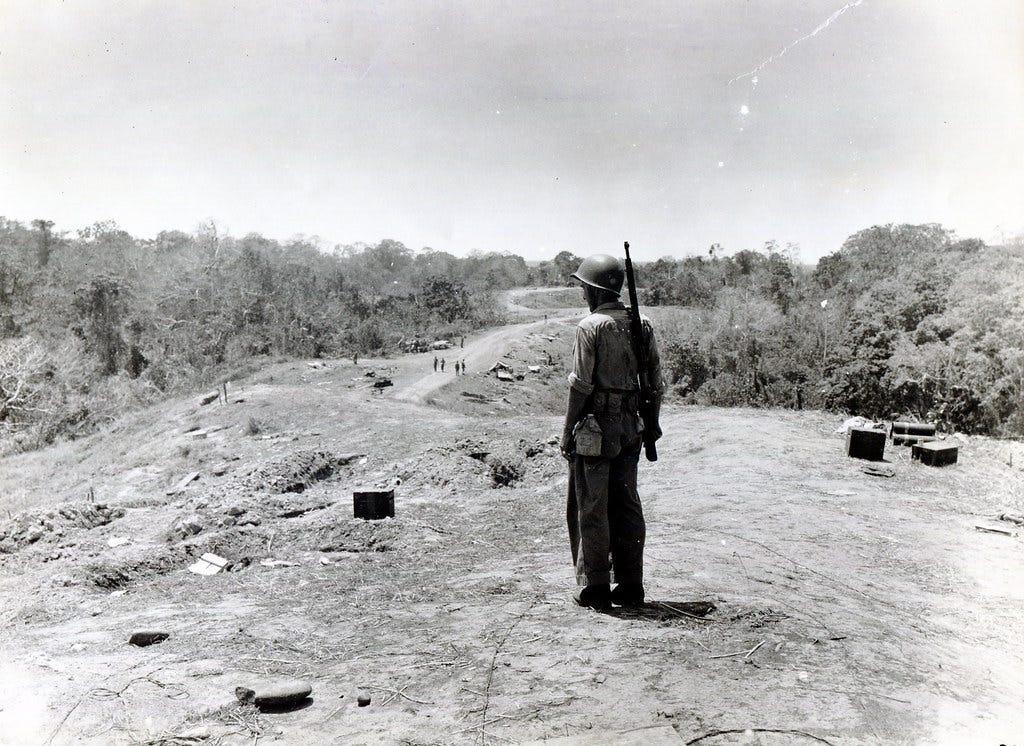
By night the Japanese moved troops into eastern Guadalcanal. General Kiyotake Kawaguchi led his men into the jungle, marching toward the gaps behind Henderson Field. He left behind a rear guard and much of his supplies at Tassimboko. Two days later Colonel Merritt “Red Mike” Edson's Raiders came ashore to rout the rear guard and destroy the supplies.
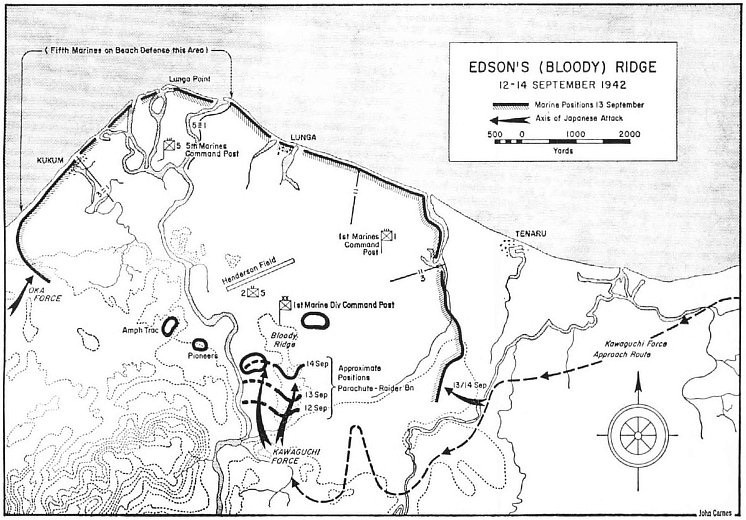
The Raiders had just come over from Tulagi, and after their raid on Tassimboko they were plugged into one of the gaps behind the American airfield. They set up there defenses on the south end of a north-south running ridge. This ridge commanded the airfield and General Vandegrift was aware of its importance when he sent Edson's men up there. Oddly, however, he placed his command post below the south end of the ridge.
In the second week of September the signs were clear that a major battle was pending on the ground. On the 12th came the prelude as furious air battles raged over Iron Bottom Sound and Henderson Field. Enemy bombers also flew low to blast the Marine positions on the ridge. When night fell it was clear and moonless.
At 2100 hours (9:00 pm) a Japanese patrol plane dropped a flare over Henderson Field. Thirty minutes later the 8- and 5-inch guns of an enemy cruiser and three destroyers opened fire on the ridge behind the airfield. Then, after another twenty minutes, Kawaguchi struck.
His men had marched down the bank of the Lunga River, wheeled right, and then, in the light of their parachute flares, charged forward in waves. First came the grenadiers, then the riflemen and light machine gunners. They came in columns stretching as far back as the Marines could see. Slapping their rifle butts they began shouting in a rising, rhythmic chant:
"U.S. Marines be dead tomorrow! . . . U.S. Marines be dead tomorrow!"
The Raiders were driven back, their center split. A platoon was cut off on the right flank. The Japanese moved down the Lunga, attempting to encircle the Marines. The situation was serious. But Kawaguchi's attack broke down as discipline dissolved. Instead of overwhelming the ridge, the Japanese merely flowed up against it. They thrashed about in the jungle, confused. The battle became fragmented, man against man, hand-to-hand. When daylight came, the Japanese retreated back to their assembly areas. But the fact remained that they had pushed the Marines back.
It was only round one. Both sides spent the day of September 13, preparing for round two.
—
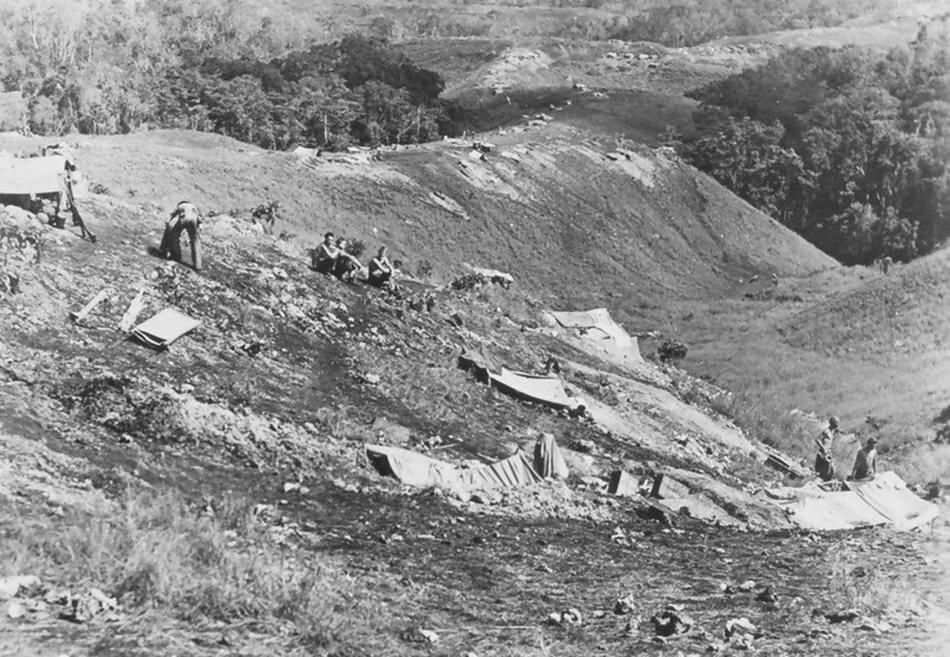
The Raiders were stunned. They had been driven back, and they did not like it. A battalion had been sent to provide relief, but it was stopped by the constant action in the air over the perimeter. The battalion did not arrive until dusk, and even then it could only take up a supporting position. It remained the task of just 400 Raiders and Paramarines to hold a 1,800 yard-long line against the expected assault of 4,000 Japanese. Red Mike Edson gave them
the word:
"This is it," he said. "It is useless to ask ourselves why it is we who are here. We are here. There is only us between the airfield and the [Japanese]. If we don't hold, we will lose Guadalcanal."
By contrast, the Japanese were confident. They had broken through the deadly firepower of the Americans. They believed that they had proved the superiority of spiritual power. They cheered throughout the day as planes from Rabaul bombed American positions. General Kawaguchi was so confident that he planned to attack earlier than scheduled. He wanted to take the airfield before the Imperial Navy arrived at midnight to bombard it.
At 1830 (6:30 pm) the Japanese attacked. "Gas!" someone shouted. Flares lit up the night sky and smoke spread over the Marine right. Again came the precise and un-American voice, "Gas attack!" Nobody was fooled.
Hundreds of short tan shapes came screaming out of the jungle. "Banzai!" "U.S. Marines be dead tomorrow!" The Marines fired back with their own coarse epithets. They fired their rifles and machine guns, too, and Japanese soldiers began to fall. Now a full battalion -- almost 1,000 men -- hit the right flank and fragmented it.
Private First Class Jimmy Corzine spotted four enemy soldiers on a knob above him. They were setting up a machine gun. Without hesitation he charged. First he got the leader with his bayonet, then he grabbed the gun and turned it on the others. Then he fired on the charging Japanese, and kept at it until he was killed.
To the left of the company on the right flank, the Paramarines were driven back by a mortar supported charge. Captain Harry Torgerson took charge, rounding up the men as they drifted to the rear. He challenged them to go forward, calling each by name. Through falling grenades they charged up a bare slope and set up their machine guns. Once in position those guns cut down the Japanese in front of them. The enemy answered with grenades fired by the mis-named knee mortars (more than one American messed up his knee while attempting to fire the mortar they way the name seemed to suggest). Sergeant Keith Perkins was all over the ridge looking for ammunition for his two guns while his gunners fell dead or wounded. Taking up his last gun, Perkins fired it until he, too, was killed.
Edson tried to contact the company on the right. Over his field telephone he heard a strange voice. "Our situation here, Colonel Edson, is excellent. Thank you, sir." After he finished cursing, Edson grabbed a corporal well known for his loud voice. Then, running forward, the corporal cupped his hands to his mouth and shouted "Red Mike says it's okay to pull back!"
The company on the right flank heard and withdrew. Edson shortened his line gradually. At one point he saw a group of Marines wandering around aimlessly. "The only thing they have that you don't is guts!" he screamed at them. But more men were drifting to the rear, and Edson, with Major Ken Bailey, tried to rally them with taunts. Bailey recalled the immortal cry of Dan Daly at Belleau Wood in the last war. "You, you son of a b____!" he yelled. "Do you wanna live forever?" The taunt worked and the men went forward to dig in once more.
The Raiders now dug a shallow horseshoe defense on top of the ridge. There they waited for the final thrust of the Japanese. But Edson didn't wait, instead calling for artillery. His spotter marked the enemy's rocket fire, directing redoubled fire on their assembly areas, and then he brought the fire closer and closer to his own lines. The spotter had started the night a corporal, but by morning Edson would make him a second lieutenant.
The rain of steel fell among the troops of both sides. Japanese soldiers dived into Marine foxholes, only to get knifed and thrown right back out. The enemy fell back exhibiting their biggest weakness, the inability to be quiet in the jungle.
At 0200 they came again, preceded by another mortar barrage. "Marine, you die!," they shouted, but not with as much fervor as they had with the first attack seven and a half hours earlier. The Marines, smelling victory, replied with curses and bullets. Thirty minutes later Edson radioed to Vandegrift, "We can hold."
In the morning they counted the bodies. Six hundred Japanese had been killed, compared to just forty Marines, plus 104 wounded. The Raiders and Paramarines had held. Kawaguchi's men began a retreat of horrors. One officer wrote in his diary: "I cannot help from crying when I see the sight of those men marching without food for four or five days and carrying the wounded through the curving and sloping mountain trails. The wounds couldn't be given adequate medical treatment. There wasn't a one without maggots. Many died."
The Battle of Bloody Ridge was a great victory. But the fight for Guadalcanal wasn't over. There were more battles to come. A Japanese prisoner captured on Edson's Ridge (as it also came to be known) spoke ominously: "Make no matter about us dead. More will come. We never stop coming. Soon you all be Japanese."
—
John Costello writes in his book The Pacific War:
General Kawaguchi, with less justification [than Colonel Ichiki three weeks earlier], suffered from the same fatal over-confidence, which led him to believe that with three times the force of the failed first offensive, he could capture the American positions by September 13 [1942]. He had devised what he thought was a foolproof three-pronged assault plan. His detachment would divide east of the Ilu (Tenaru) River, the main body would smash into the rear of the Marines' defense perimeter, while his secondary force drove against the airfield from the west, and a contingent of Imperial Navy Marines landed at Lunga Point to coordinate an attack on the other side of Henderson Field.
Thanks to continuous surveillance by Clemens's scouts, General Vandegrift was forewarned of Kawaguchi's movements. So when Edson's Raiders returned from the Tasimboko operation, they were sent forward to establish advance defenses along the ridge of high ground that stood clear of the jungle overlooking the rear of the perimeter. . . .
The suicidal Banzai charges succeeded by their sheer weight and remorselessness in forcing Edson's battalion to pull back his line to withing 1,000 yards of the end of the runway by dawn, as the bodies piled up in front of them littering the ridge like human chaff. But Kawaguchi ran out of live bodies before the Marines ran out of live ammunition to keep their red-hot machine guns blazing away. By first light, Marine fighters took off to strike the enemy regrouping in the jungle behind the ridge. The Japanese flank attacks were no more successful in penetrating the American perimeter than the mad frontal assault. . . .
When news of their humiliating defeat reached the 17th Army Headquarters at Rabaul, General Hyakutake's staff officers were reduced to foot-stamping fury. Admiral Yamamoto was inclined to agree with his staff prediction that nothing short of a full division assault could retake Guadalcanal.
Sources:
Costello, J. (1981). The Pacific War: 1941-1945. New York: Rawson, Wade.
Leckie, R. (1987). Delivered From Evil: The Saga of World War II. New York: HarperCollins Publishers.